The system captures, not the model
Conversations are imported every five minutes and archived raw every night. Nothing is ever deleted, and secrets are detected before anything is stored.
IaGents AI-powered business automation
What you decide with your agents is not lost when the session closes: it stays current until you change it.
Discuss a deployment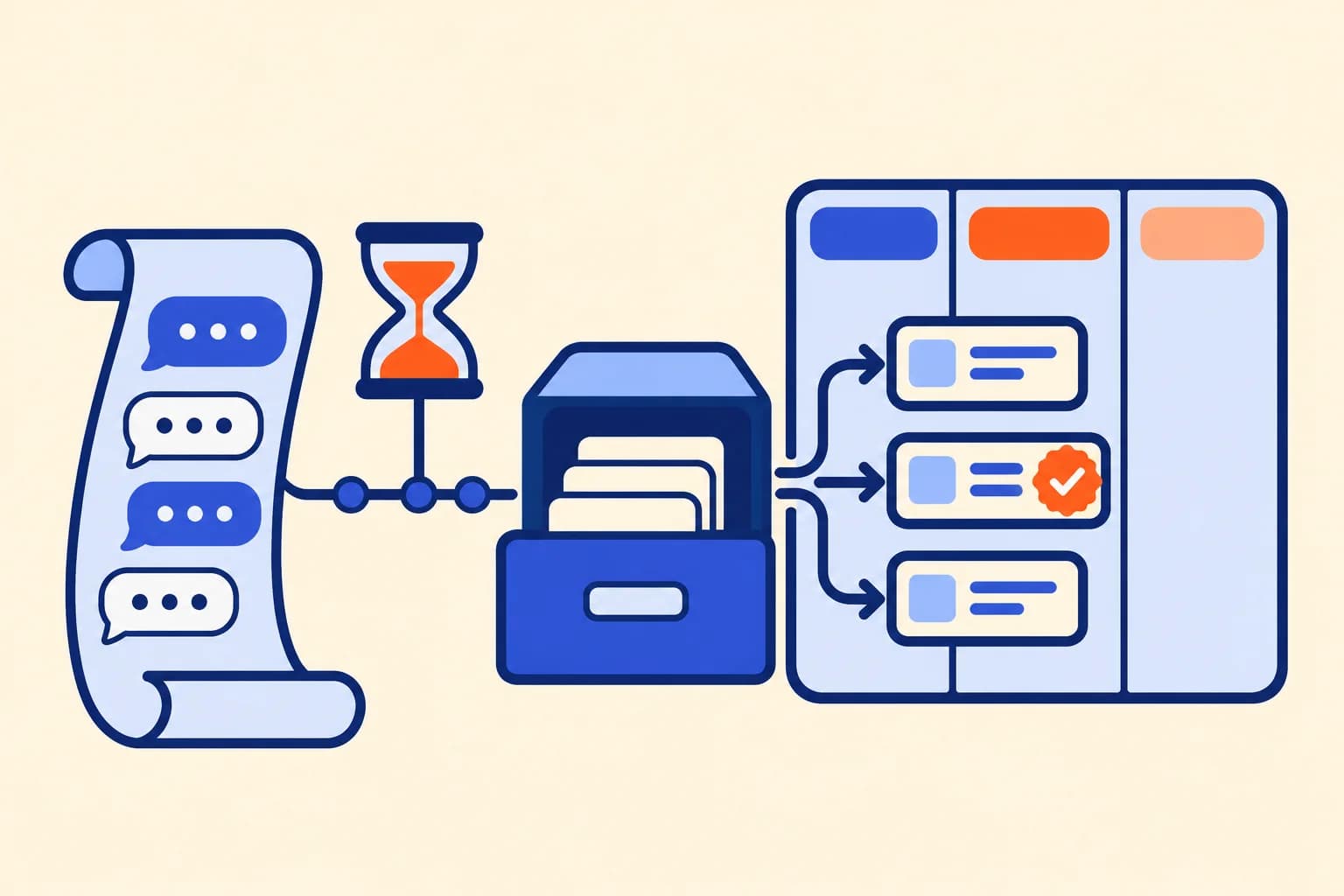
A person decides at this step
The system makes the proposals. Approving, superseding, or forgetting is always up to a person.
Agent tools delete or compact their own conversations. Whatever was decided in them ends up scattered across transcripts that disappear, handwritten notes, change requests, and tickets. A few weeks later nobody knows what was decided, what is still pending, which pages or tickets were touched, or in which conversation it happened.
This service gives every decision a lifecycle (current, superseded, expired, or open question) and a provenance that reaches the exact message. And it puts a person in the only place where approval happens.
Capture is done by the system, not the model: coding agent conversations are imported every five minutes and archived raw every night, with nothing ever deleted. Each conversation is assigned to its project by the repository it happened in, and each reference (ticket, page, change request, or document) is recorded with what was done to it: created, modified, consulted, or mentioned. A secret detector runs before anything is stored, and tool results are not kept.
Every thirty minutes a summary comes out with three sections: done with evidence, pending, and open questions. With it come up to five typed proposals (decision, question, fact, preference, or procedure), deduplicated; a proposal can supersede a current decision.
Proposals are born as proposals. They are only approved, edited, superseded, or forgotten from the panel, under a person's session. If an agent tries to approve something, the platform rejects the request: an agent never approves its own work.
When a new session starts, or after the tool compacts the conversation, the agent receives at most 2,000 characters with the current decisions and read-only tools to look up the rest. You see "since your last visit."
Agents also leave notes on what still needs documenting. A nightly pass reconciles them against the current code and proposes whether they are still alive, with proof from the commits or change requests that resolved them. You confirm.
A panel with the current decisions per project, their history, and the open questions; the answer to "which conversation created this page"; and the proposal queue, which never loses one. Per project, you decide whether its content may go out to external models, and projects marked as denied never do. Monthly spend has a configurable cap.
We install it on top of the coding agents you already use and define with you what counts as a decision, who approves, and how often it is reviewed.
Engineering and product leaders who already work with coding agents and have lost at least one important decision to a compacted conversation. Today it is the memory of one person and their agents on one machine; we say it that way because that is what is in production.
The system has been in production since late October 2026 within our own team, on our own coding agents. The figures in this text are design figures: import every five minutes, distillation every thirty, 2,000 characters of context, and a proposal queue with no loss. We do not yet have usage figures from clients, and we do not give any.
Conversations are imported every five minutes and archived raw every night. Nothing is ever deleted, and secrets are detected before anything is stored.
Current, superseded, expired, or open question, with provenance down to the exact message and the answer to "which conversation created this page."
Proposals are approved, edited, or forgotten in the panel under a person's session. If an agent tries, the platform rejects the request.